

TL:DR I didn't get it, but I did learn an unreasonable amount about how universities are thinking about creators and the future of education, which I'm going to start sharing over the next few weeks. I'll talk about The Athletes, The Alumni, and The Educators.
But lets start with Part 1: The Schools.
To talk about higher education in the US right now, we have to start with 3 different facts.
1.The United States has a child shortage.
It's been in free fall since before the Great Recession, and we are just now starting to see the effects.
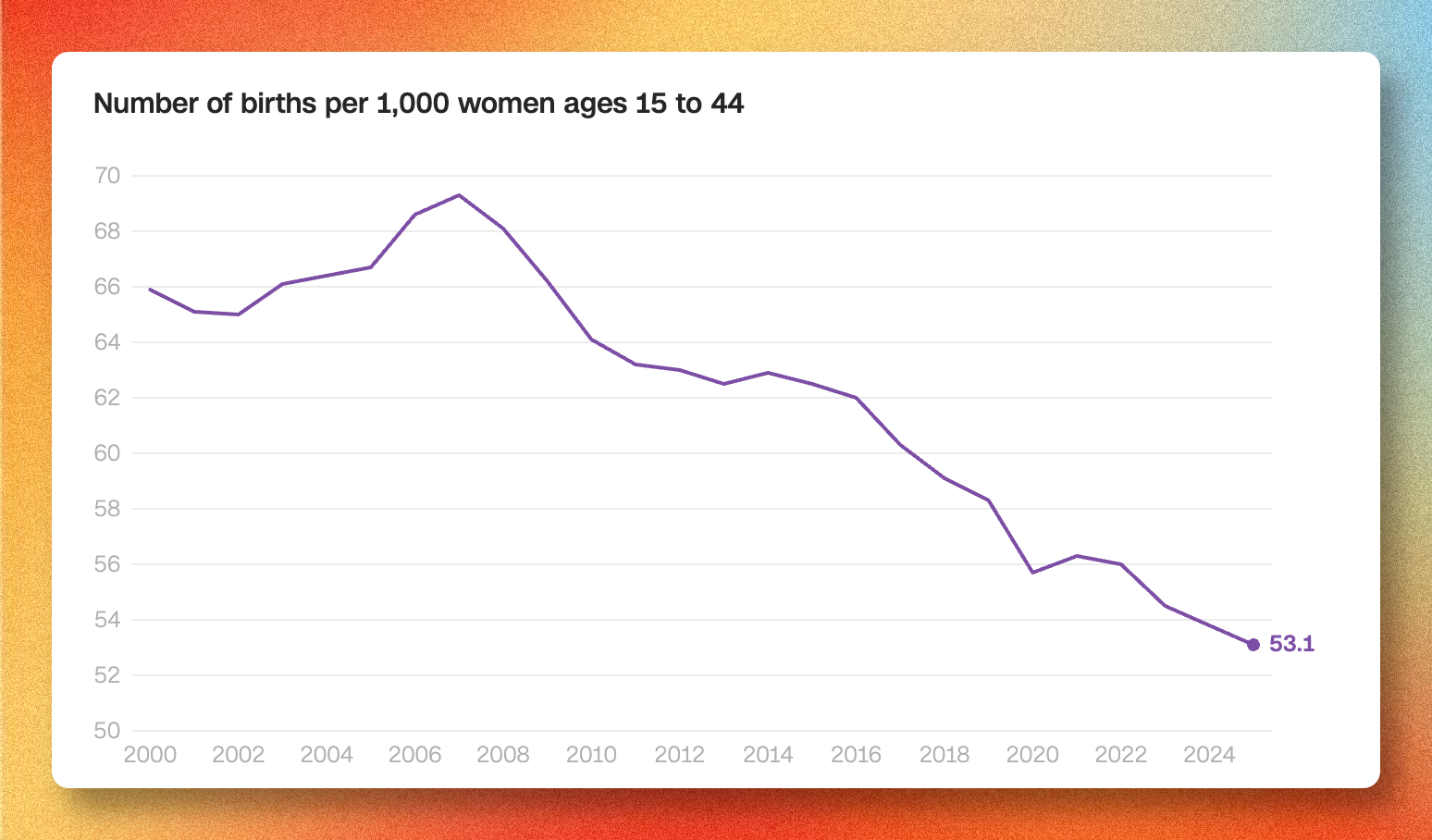
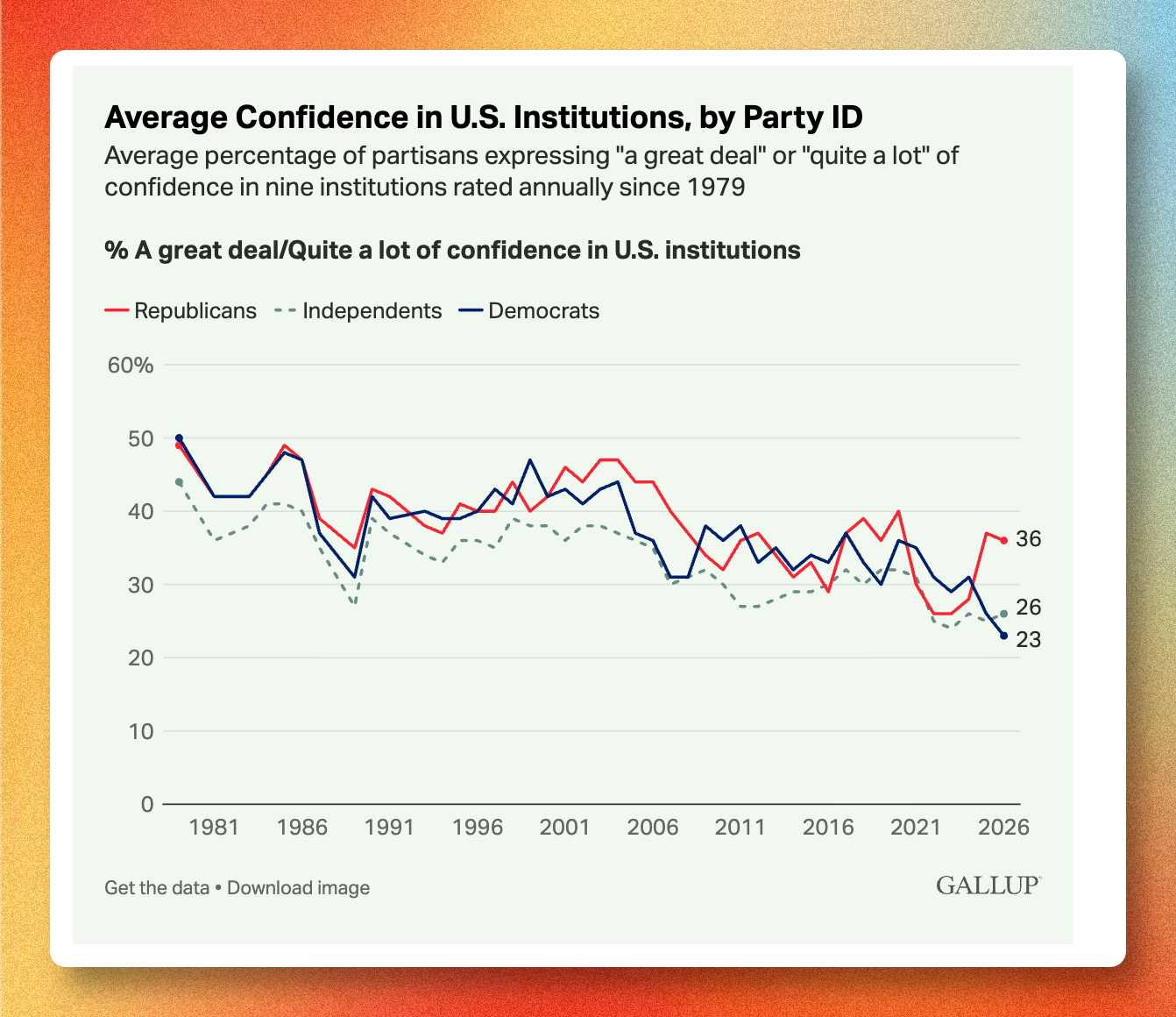
2. We don't trust anything.
We barely believe anything anymore. That's not good, because it has a real impact on the business model for college. It's one thing to change your major. It's another to lose all belief that going to college even makes sense and it is a waste of time.
3.The labor market is brutal, confusing, and full of half truths.

Much of it is, as one commentator puts it, corporate theatre. The entertainment All of these things set the backdrop for a very confusing rebrand for universities, who are tasked with helping students prepare for a world that no one quite understands.
Follow the (endowment) money.
The other reason that the college ecosystem is important, is because it funds the venture ecosystem.
In our last episode, Brian Hollins from Collide Capital, talked about how he cold emailed the Chief Investment Officer of the University of California System. They put in $11M for their first fund, and $15M for their second.
What we didn't get into, is the scale of the UC system. It's huge:
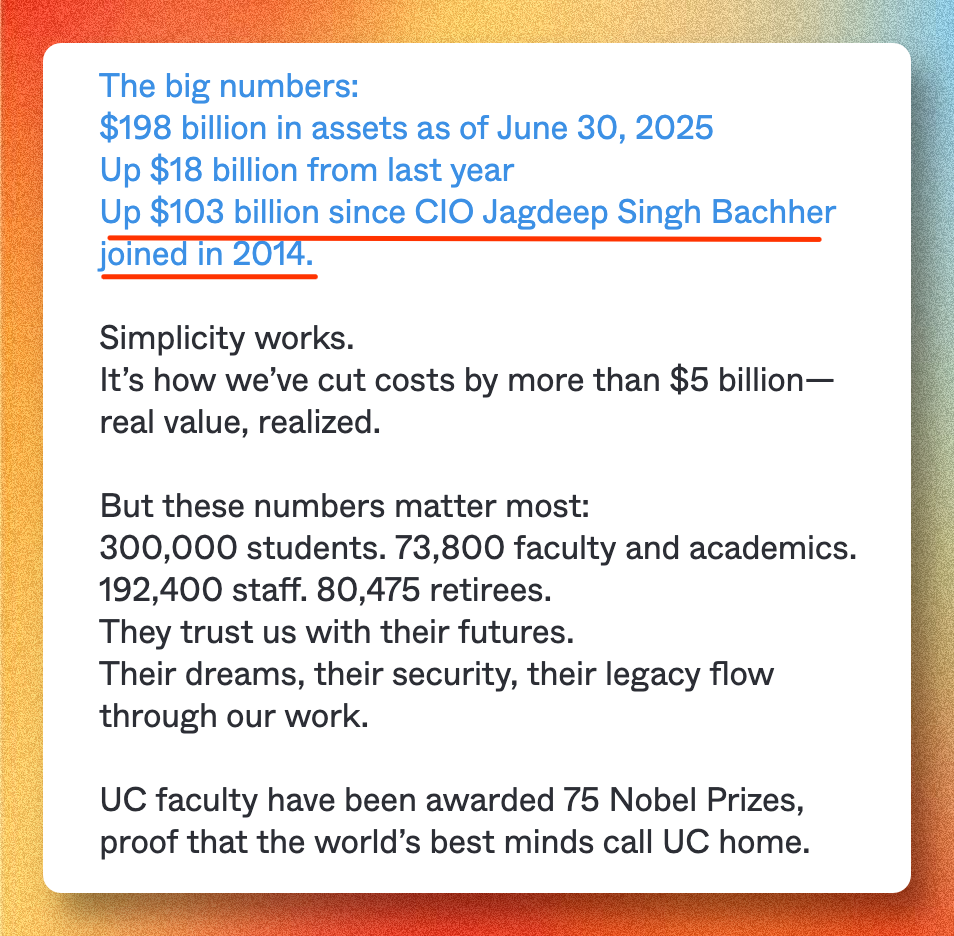
UC has a different set of clients: students, faculty and staff,
retirees, and the University of California’s 10 campuses and six academic health centers. That's who they serve. To do that, they have to manage risk and find new opportunities. Which is why they are invested in all kinds of things, and keep a public record of all their private investments. But it's not just funds that take endowment money.
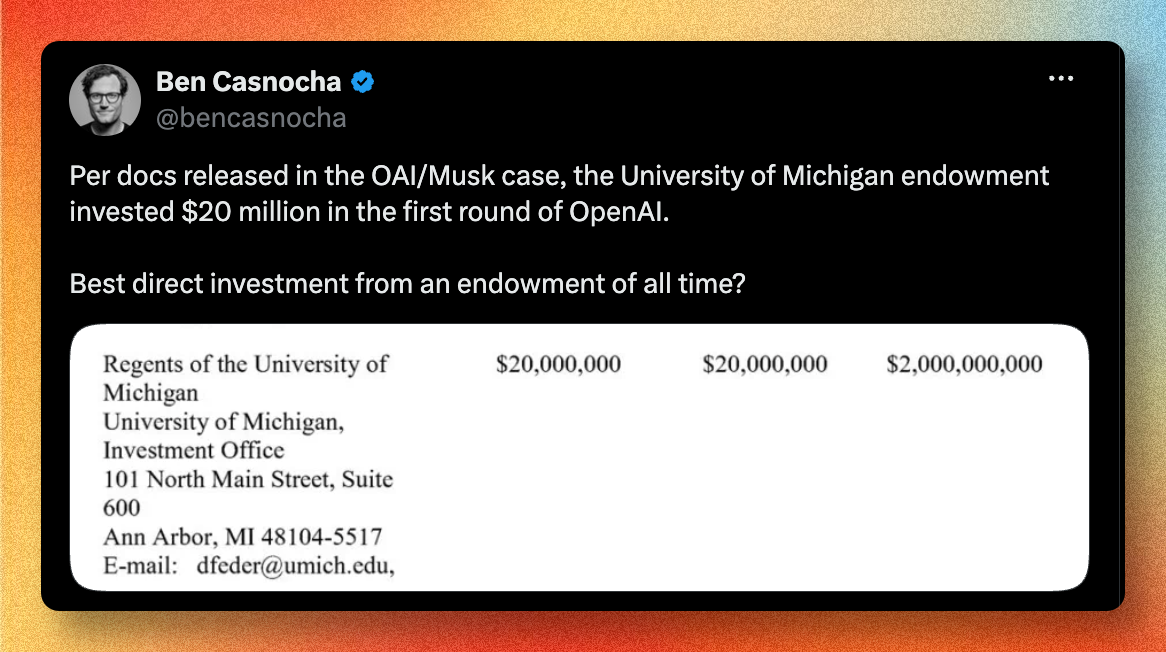
Remember when Elon was beefing with OpenAI? Well they went to discovery, which means documents. In those documents, we got to see who invested in OpenAI early. There was a university who made a killing:
At the same time, the market has been punishing schools who have portfolios that may be overexposed to specific types of capital.
The Prestige Olympics

The kind of school you go to doesn’t just decorate your LinkedIn. It plugs you into a specific status and signal system. That status still matters, and it shows up in hard numbers, especially in fields where people are literally paid to price risk. It's easy to say it doesn't matter, but it's incomplete.
A recent study followed more than 100,000 venture capitalists and rebuilt their careers from old firm websites and commercial data. The researchers asked how much money each person actually made for investors over their lifetime, and compared that to where they went to school.
A few takeaways:
- VCs with Ivy League or “Ivy‑adjacent” undergraduate degrees (Stanford, MIT, etc.) generated, on average, tens of millions more in lifetime profit than peers who entered the industry in the same year. In many cases, the gap is on the order of $50–$100 million per person.
- A generic MBA is not a free upgrade. In this dataset, having an MBA at all is associated with less lifetime profit—again, on the order of tens of millions.
- A degree from places like Stanford GSB or Harvard Business School is correlated with individual partners generating well into nine figures more for their investors over a career than otherwise similar VCs.
The talk about “elite schools,” is not theoretical, nor is it reduced to raw intelligence. In the parts of the economy where universities recycle their endowment money into venture funds, the educational hierarchy is literally encoded in who gets to run the money—and how many millions they end up returning (which is the necessity of being a venture capitalist, because it's not your money!)
This is not to say that the only way to make it is to go to a specific school. I could write 15 different essays on outliers (I in several respects am one myself). It is to say that specific schools do give access and entrance into particular networks that also have distinctive impacts on certain aspects of your career.
This is in part why "going to college" still matters, specific to the what people are solving for. It is not everything, but it is something, and in certain career fields, it can mean something very specific.
The University Response
Schools have been trying to adjust to these rapid cultural shifts around the creator economy, and are coming up with a variety of solutions.
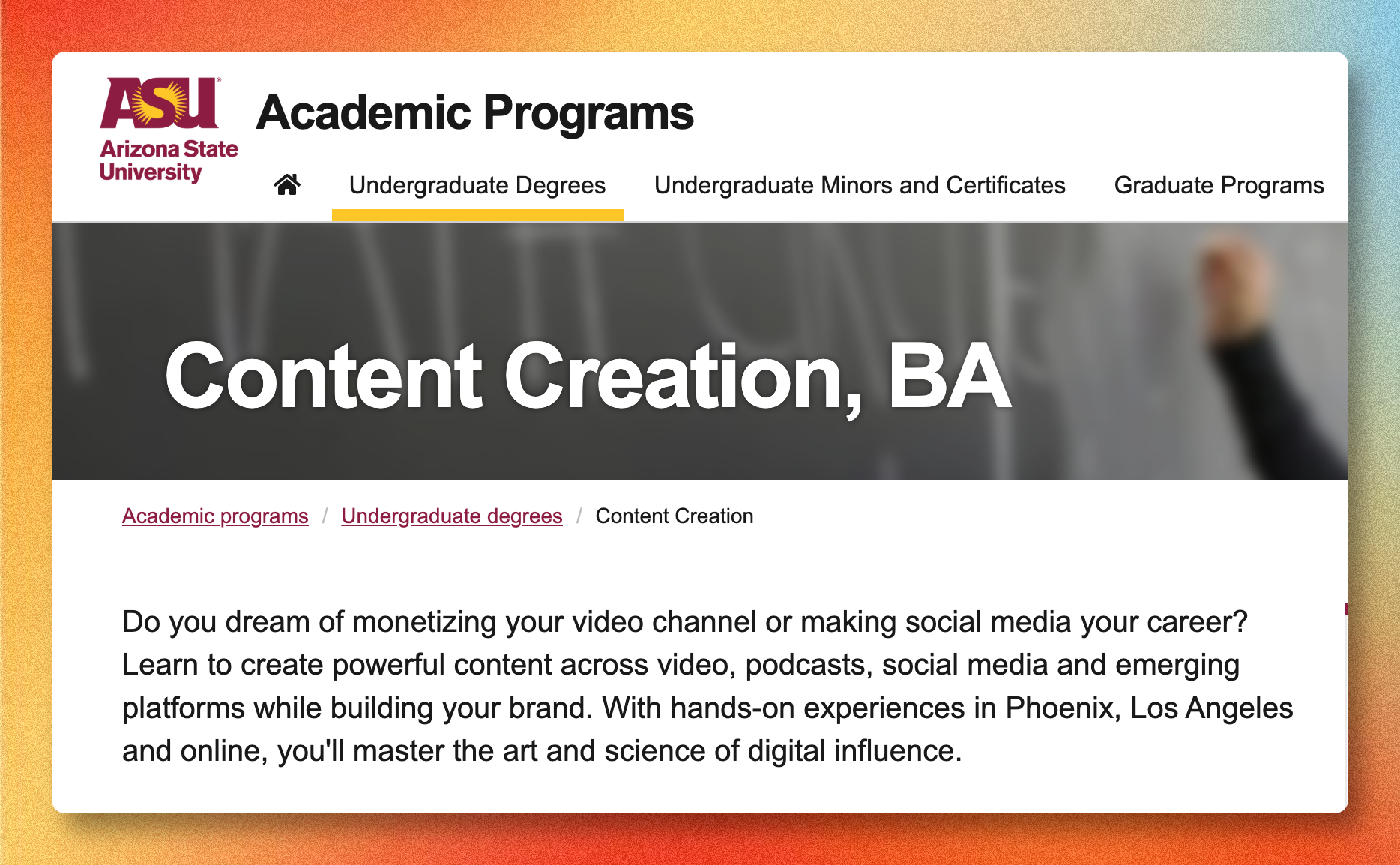
Arizona State has a Bachelors in Content Creation:
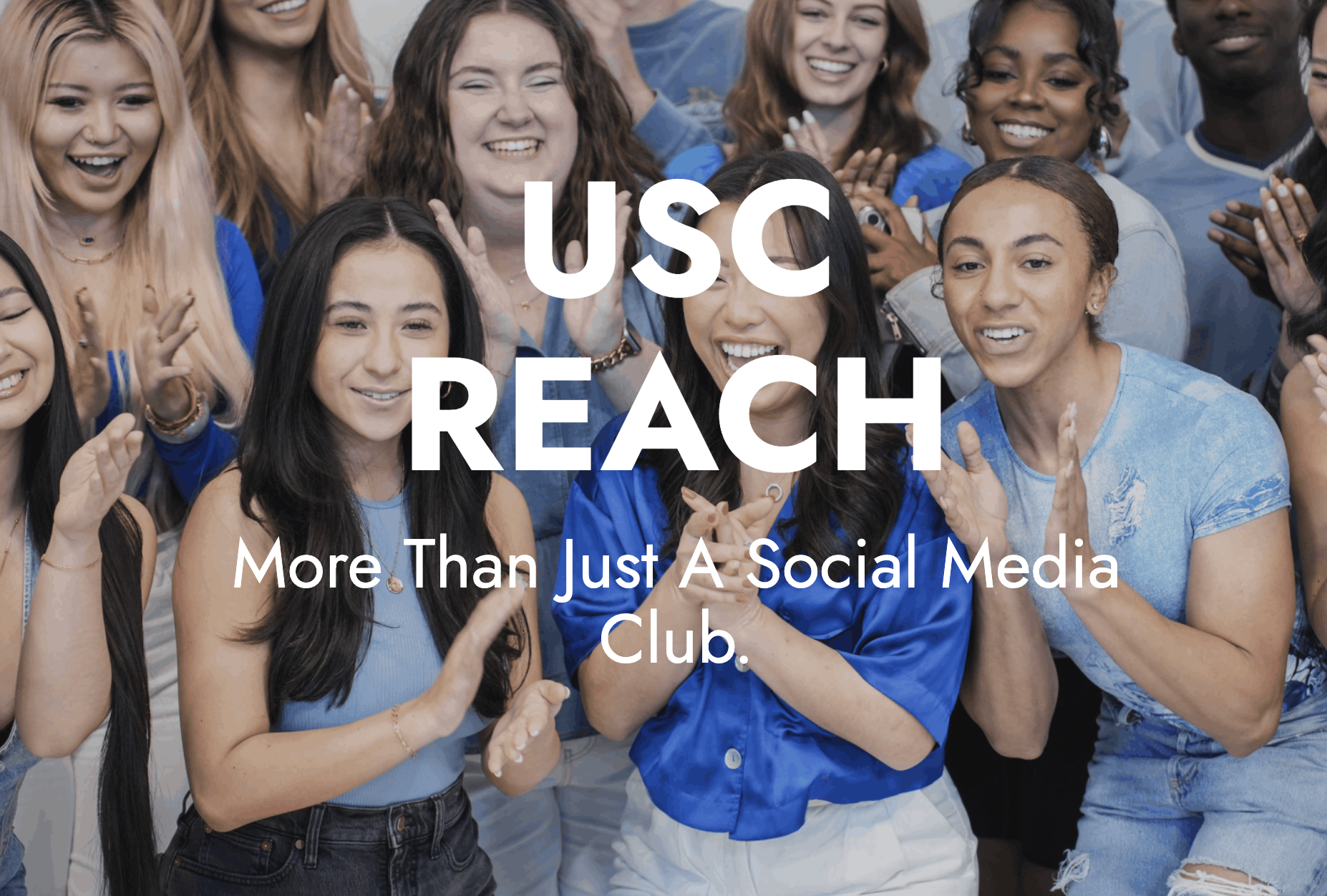
USC built a club exclusively for college creators, and scaled it to other schools:
But one school has fully committed to the shift: Syracuse.
The Syracuse Creator Economy Center
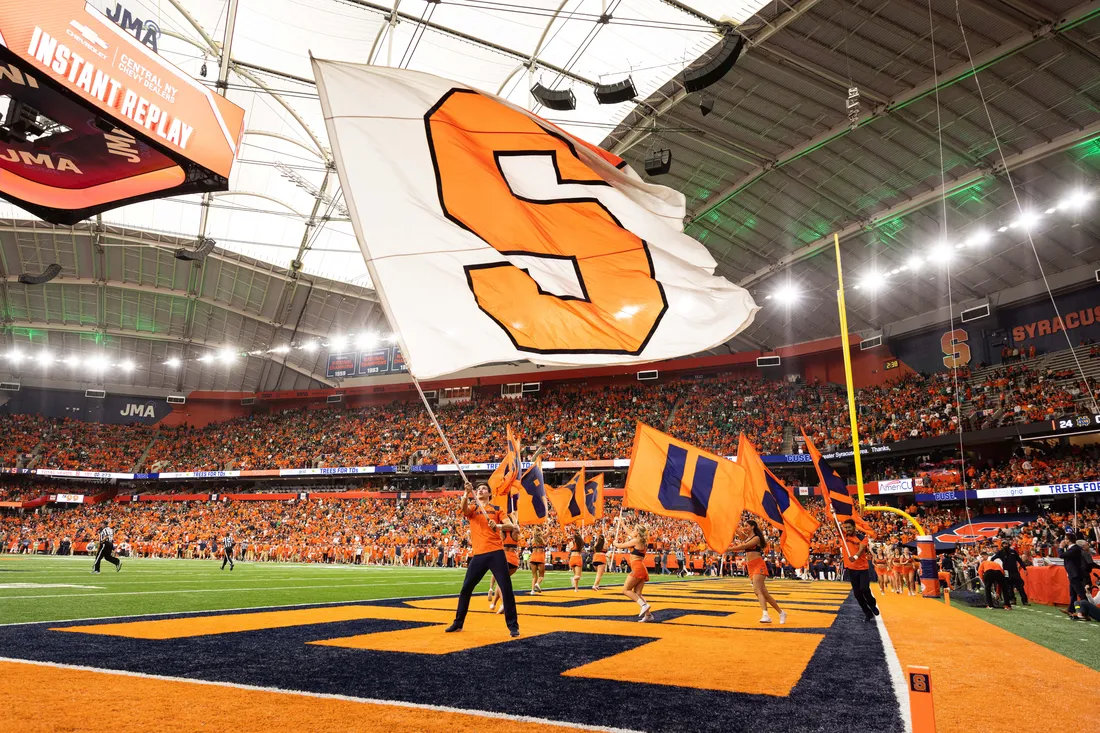
Syracuse University is attempting to change this, by bringing all of this together in their new Creator Economy Center. They just hired their first Executive Director, and are off to the races. They have a few advantages going for them.
1.The best communications school on earth (Newhouse)
Newhouse gives Syracuse a native, institutional foothold in the one part of the economy (media + creators) that’s actually growing in power as trust in everything feels like its collapsing.
2. D1 Athletics
Syracuse also plays in the top tier of college sports. Division I athletics isn’t about school spirit; it’s about distribution. It gives the university a constant, renewable stream of live content people actually care about—games, rivalries, tournaments—and a cast of built‑in characters in athletes and coaches.
- 250,000+ alumni all over the world
For students, that means four years in Syracuse quietly buy you decades of optionality: who will pick up your call, amplify your work, hire you, wire into your fund, or put you on air. In a labor market full of half‑truths and “corporate theatre,” that kind of downstream surface area is one of the only real hedges—especially in fields, like venture and media, where relationships literally are capital. Also, its helpful that those "alums" are people like Speedy Morman. - It's private
A private university leans much more heavily on its endowment and donors, which ties it directly into the same venture ecosystem that allocates risk everywhere else. It has tighter control over its governance and brand, so it can move faster than a public system constrained by state politics and budget cycles (like UC). It can experiment with new programs, credentials, and creator‑focused tracks without waiting for a legislature to understand TikTok.
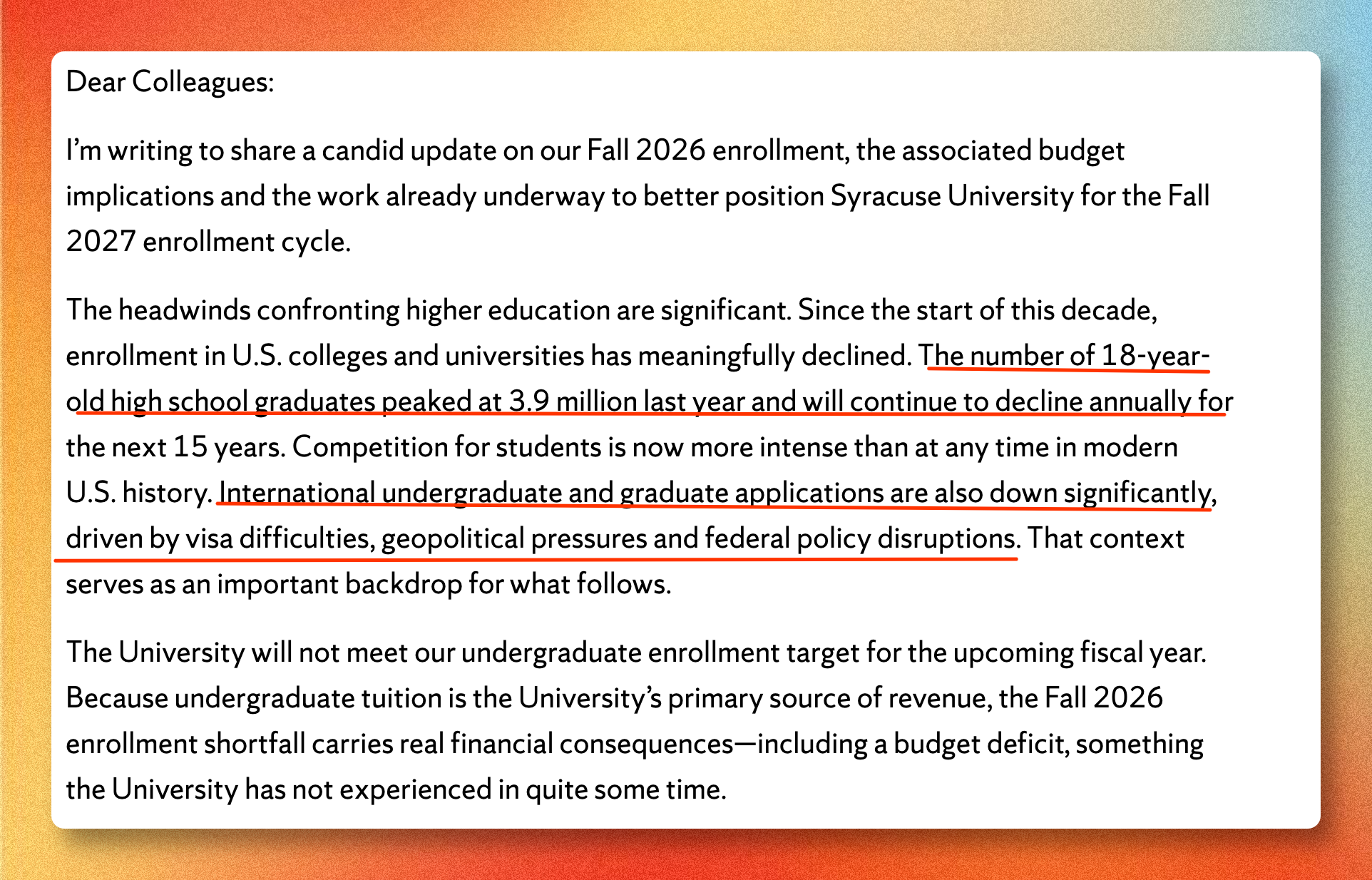
Remember the birth rate decline we talked about earlier? Syracuse missed its enrollment numbers this year because of it. Add that to geopolitics and visa restrictions, and there's real pain they have to navigate.
Here's a letter from their Chancellor explaining the situation:
So how do they weather this, and survive?
They have to build demand, desire, and new value.
Here's how they can do that.
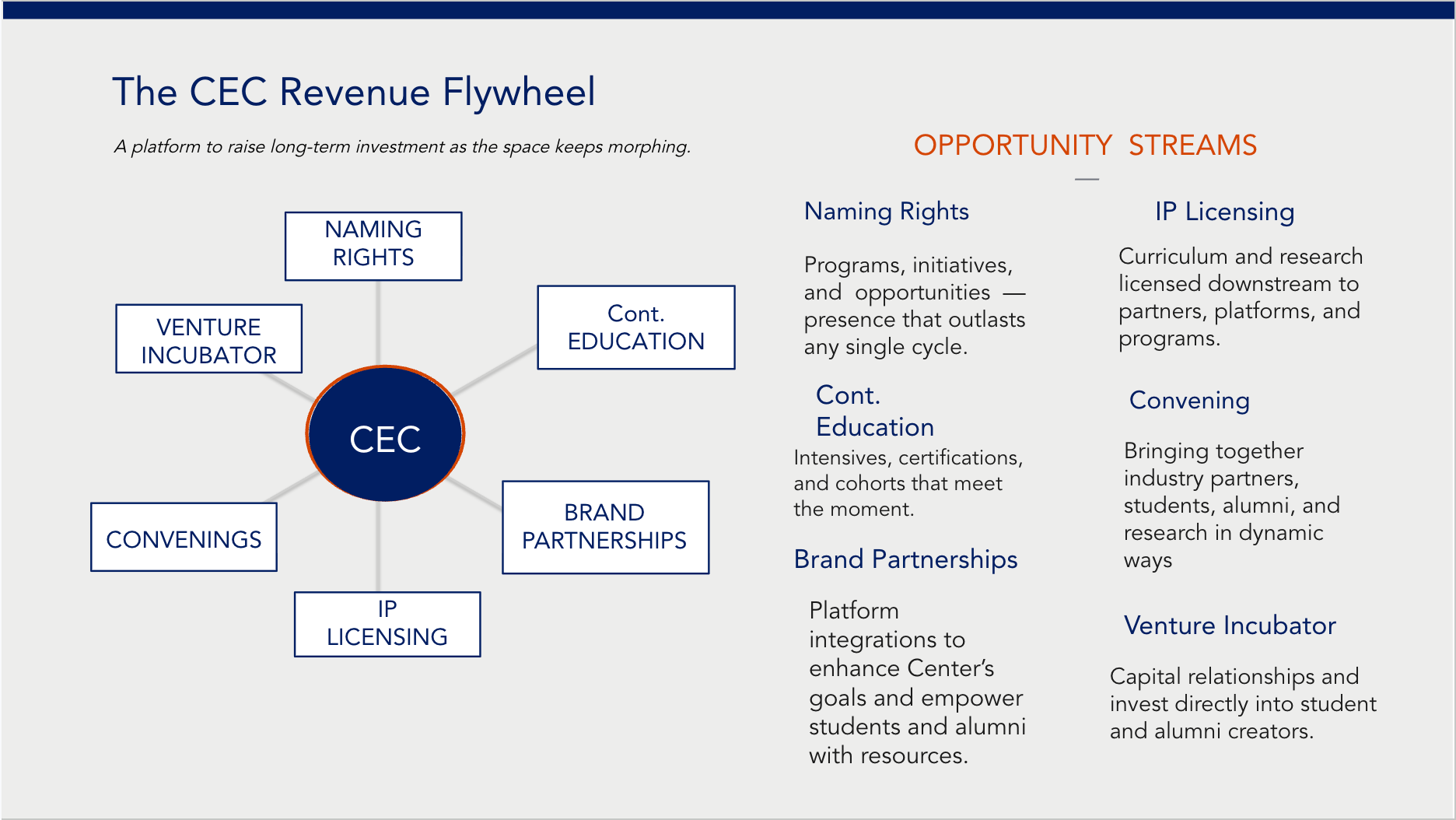
Build a Flywheel. First they reimagine their offering to 4 different cohorts: students, alumni, employers, and ecosystems. You then double down on what's working and make a flywheel over time.
It could look something like this:
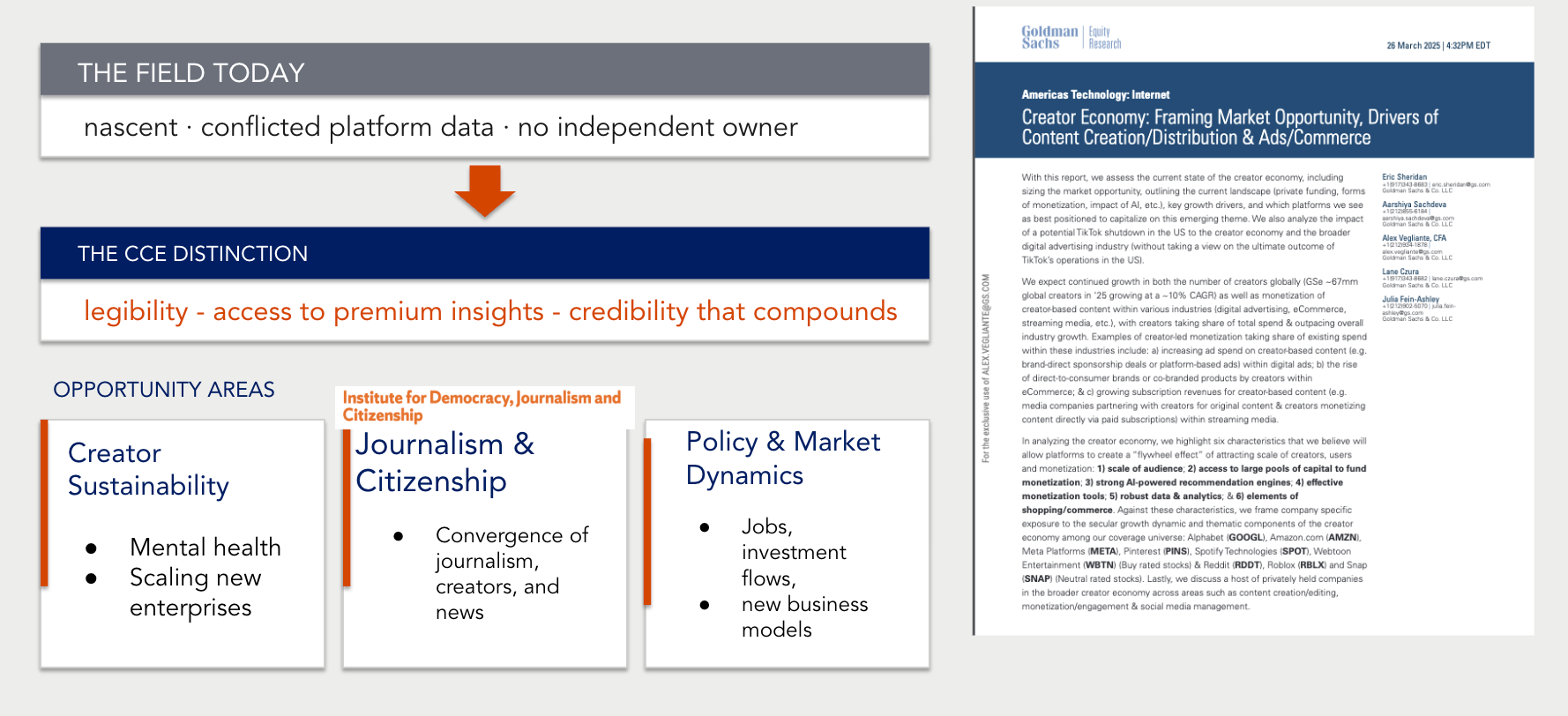
Research arbitrage. Second, Syracuse also can start publishing research about the space, because they aren't conflicted. As a research institution, they have the people, means, and reputation to create studies about things, that help test what is happening. Right now, must of the data about the creator economy is written, funded, and supported by companies who literally need to promote themselves. Syracuse has world class faculty who study marketing, law, business, and politics for a living. In a low trust environment, they could create seminal work people cite and learn from, which creates value:
Alumni compounding. Third, partners (and future employers) want talent that can show and prove. Thats where the alumni come in. Syracuse (read: Newhouse mainly) produces actual media monsters. The going nickname is the Newhouse Mafia for a reason. Syracuse has alumni in every sector of the entertainment and media landscape, and have been successful, people like:
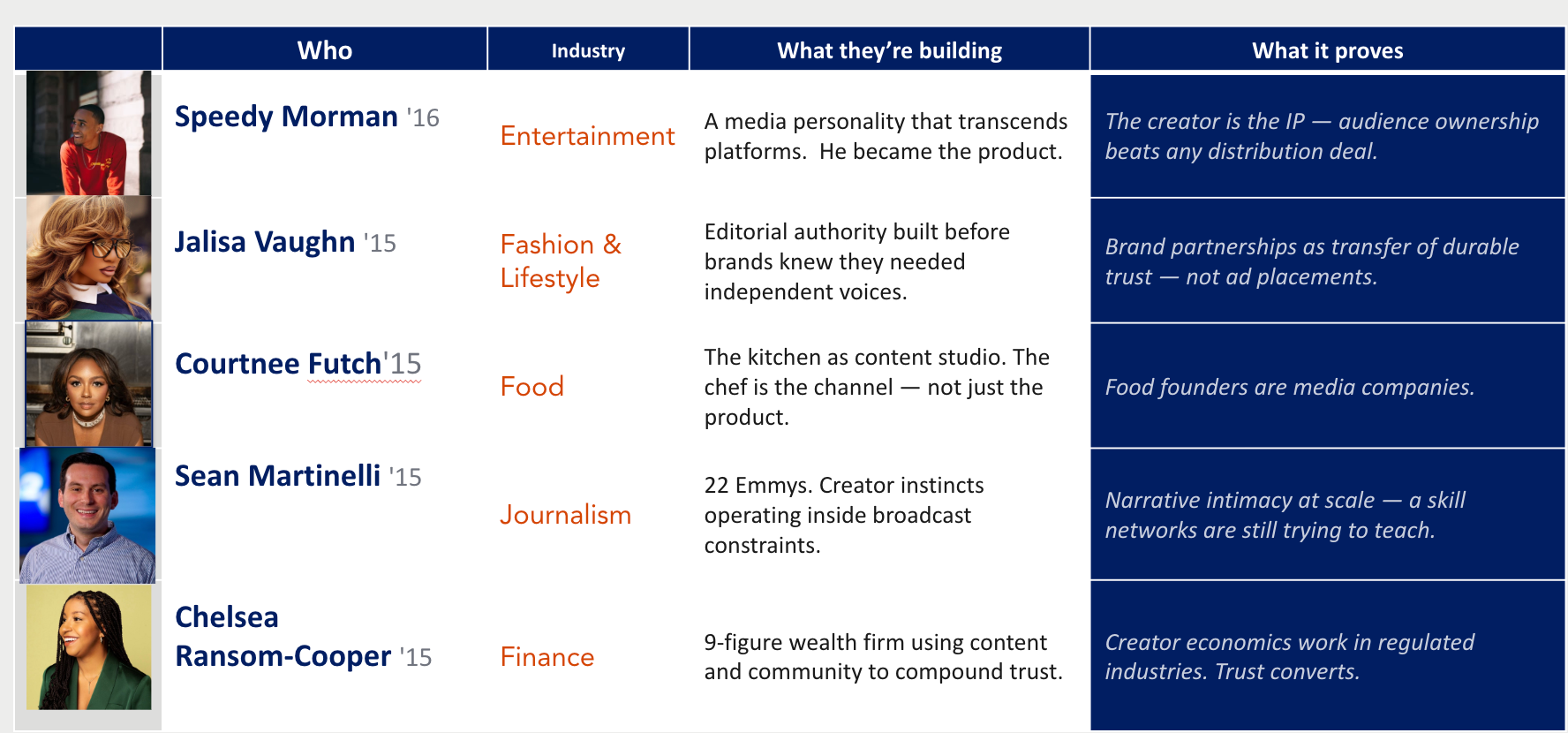
Alumni make, keep, and sustain lore. The better they do, the better the school looks, the better the story, the clearer the return is. Syracuse has thousands of active and past success stories to pull from.
1st Party Data. It's not enough to say "hey come here, and be a creator. And you have 25,000 people to engage. So Syracuse could build a campus wide dashboard/index that showed business being built, revenue being and how many creators were active, and passing through the center.
You could then license out the data, let other providers build on top of it. The index compounds, and every one on campus because an amplifier for the university. You could start comparing classes, majors, schools, and how well students are able to start and build businesses.
Again, a sample of the index:
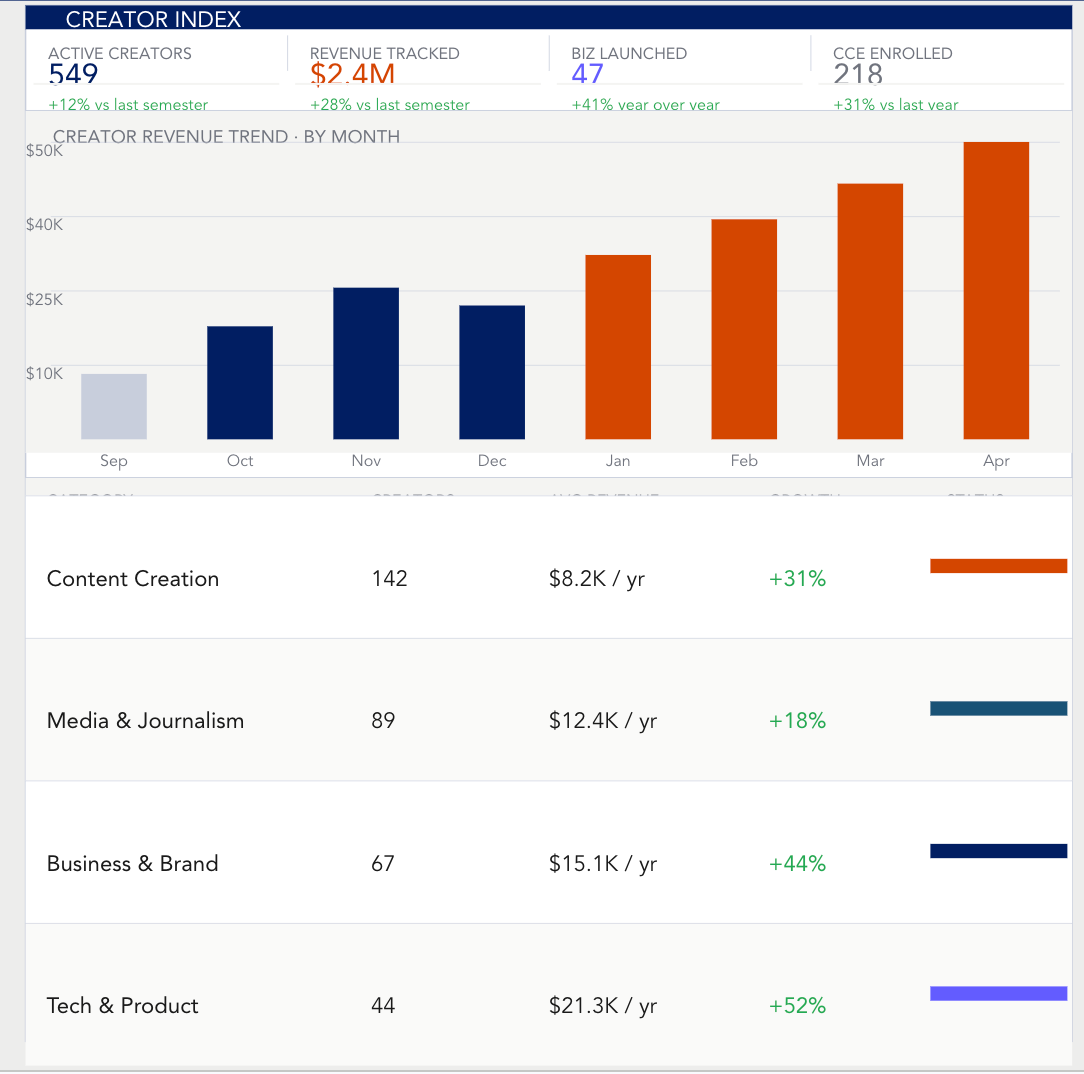
You can imagine a world where, instead of just seeing what people major in, prospective students see what kinds of opportunities are available for them to create and express, and how much they can earn per semester or year, what brands are engaging, etc.
Syracuse could start marketing the amount of small businesses that are being launched and scaled on campus, and since upstate New York is a designated technology corridor , it bodes well as a regional story too.
This isn't a novel strategy: any school with means and will could do this, with the right leadership and environment. I'm not clear its good either; there's lots of things that education is supposed to do, and ways it is intrinsically good. But schooling in the US has been a business for a long time. Right now it is having to reimagine what the value it provides will be. Those questions are both specific and existential. But anyone asking them has to start at the same place:
Is twhat students want and need for the world they are going to inherit?