

In late June 2026, with zero press release and zero fanfare, Joe Budden and Ian Schwartzman quietly launched joebuddencommunity.com, a fully owned membership platform built in-house rather than licensed from anybody. That sentence reads like a podcast update. It isn't. It's a technology story, and it's one that touches Patreon's fee structure, Whop's balance sheet, Apple's App Store cut, and eventually the $10 a month you're paying some creator right now without thinking twice about it.
Quick intro if you're new here. I'm Carl, by day I run Joseph Black Law PLLC, a New York law practice where I work on startup and venture capital transactions, entertainment and music deals, and investment fund structures. By night, and honestly during a lot of stolen lunch hours, I write The Dime💰.
The Dime💰 exists for one reason: the most interesting financial stories in America run through culture, and almost nobody covers them with both the spreadsheet and the source material open at the same time. The music press covers the artist. The financial press covers the companies. The Dime💰 covers the deals.
Today we talk about what Budden and Schwartzman actually built, why it's not the same thing as a Patreon page, and why every independent creator you follow just got a preview of where their own business is headed. Here's this week's edition of The Dime💰.
THE NUMBERS
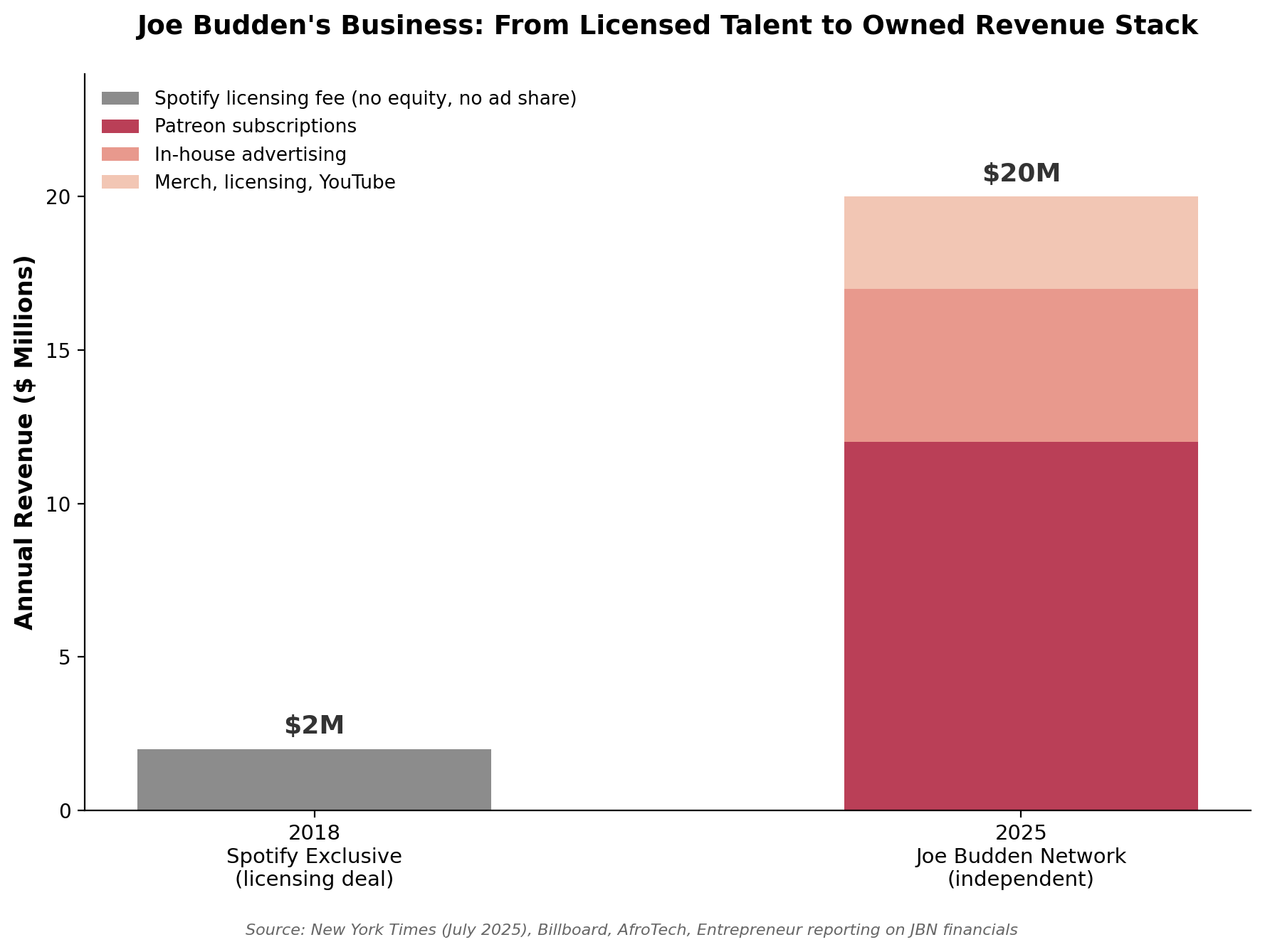
Joe Budden Network 2025 projected revenue: $20 million+, per Ian Schwartzman's numbers reported by the New York Times in July 2025. (Source: New York Times, via AfroTech and Entrepreneur reporting, July 2025.)
Patreon subscription revenue alone: $1.04 million a month average, off more than 70,000 paid subscribers paying between $5 and $50 monthly. That's over $12 million a year, making Budden Patreon's single top earner on the platform, a fact Patreon itself confirmed to the Times.
2018 Spotify exclusive deal, for comparison: roughly $2 million a year, no equity, no ad revenue share. A $44 million offer came later. It would have required pulling everything off YouTube. They said no.
30+ independent contractors work inside the network. On-air talent alone, Queenzflip, Marc Lamont Hill, Damona Love, Parks Vallely, Ish, and Ice, collectively earn more than $1.5 million a year. JBN was also finalizing a $2 million purchase of a waterfront studio space in Edgewater, New Jersey, as of last year.
WHAT THEY ACTUALLY BUILT
The Joe Budden Community is not a Patreon page with a new coat of paint. Reporting and commentary around the launch describe it as something Ian Schwartzman built in-house, not licensed from Mighty Networks, Circle, Whop, or any of the dozen white-label community platforms that exist for exactly this purpose. Budden himself joked publicly that he had nothing to do with building it, that it was all Schwartzman, which is its own small tell. The business guy built the software.
That distinction matters more than it sounds like it should. A creator using Patreon is a tenant. They don't own the code, the database, the payment rails, or the terms of service governing their own relationship with their own audience. A creator running their own app owns all four.
This isn't the first time these two have made a move like this. In 2021, when they signed with Patreon, Budden didn't just take a bigger revenue split. He took a paid advisory title, Head of Creator Equity, and structured the deal for standing and equity inside Patreon itself. They've been playing this game since before most creators knew there was a game to play.
The Joe Budden Community also isn't built like a Discord server. Instead, it's built like a standalone social network, in the same architectural family as X, Threads, Bluesky, and Truth Social. Feed, posts, follows, a native timeline. That's a meaningfully different animal than a membership tier bolted onto somebody else's app.
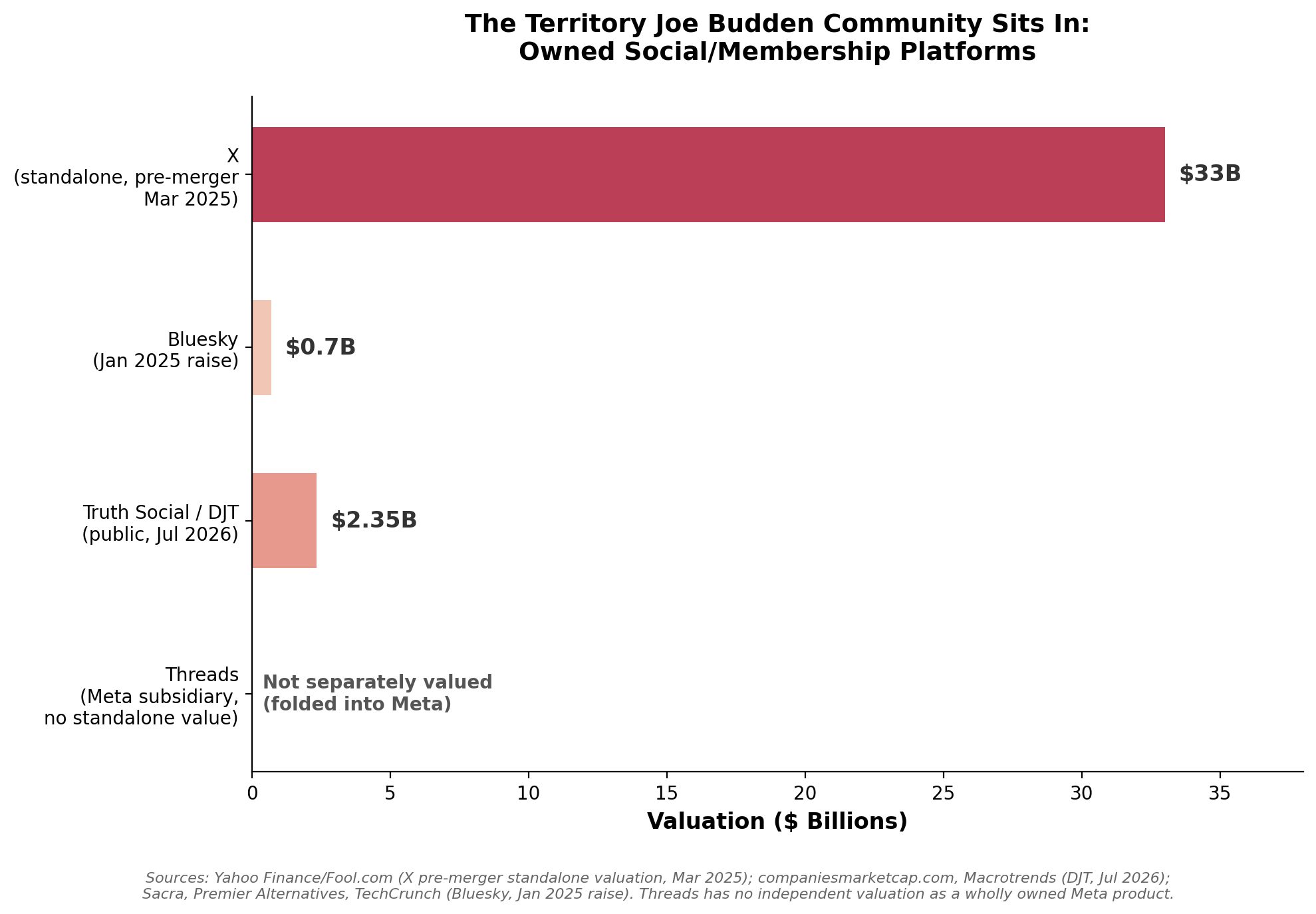
Look at where that category actually sits on a balance sheet. X was valued at $33 billion standalone right before Musk folded it into xAI in March 2025, before the whole stack got absorbed into the $1.25 trillion SpaceX entity this year. Truth Social's parent company, Trump Media, trades publicly and sits around $2.35 billion as of this month, down hard from its $8.7 billion peak in January 2025. Bluesky raised at a $700 million valuation in January 2025 off 35 million users and has since grown to over 41 million. Threads doesn't have a standalone number at all, because Meta owns it outright and never has to say what it's worth. Four different points on the map, but all four sit inside the same territory: owned social infrastructure, not rented membership tools. That's the category Budden and Schwartzman just built into, whether or not it was intentional. Either way, that value is added on top of the $20 Million per year announced in The New York Times.
THE PLATFORM TAX
Here's the part that never makes it into a fan-facing headline. Every dollar flowing through a rented platform gets taxed on the way in.
Patreon moved to a flat 10% platform fee as of August 2025. Add roughly 3% in payment processing. Then, if a fan subscribes through the iOS app instead of the web, Apple takes its own cut of up to 30% on that transaction. By the time a $10 monthly subscription clears all three layers, there's about $6.09 left for the creator. Multiply that across 70,000-plus paying subscribers and you're talking about millions of dollars a year sitting in other people's pockets, controlled by fee schedules Budden and Schwartzman don't write.
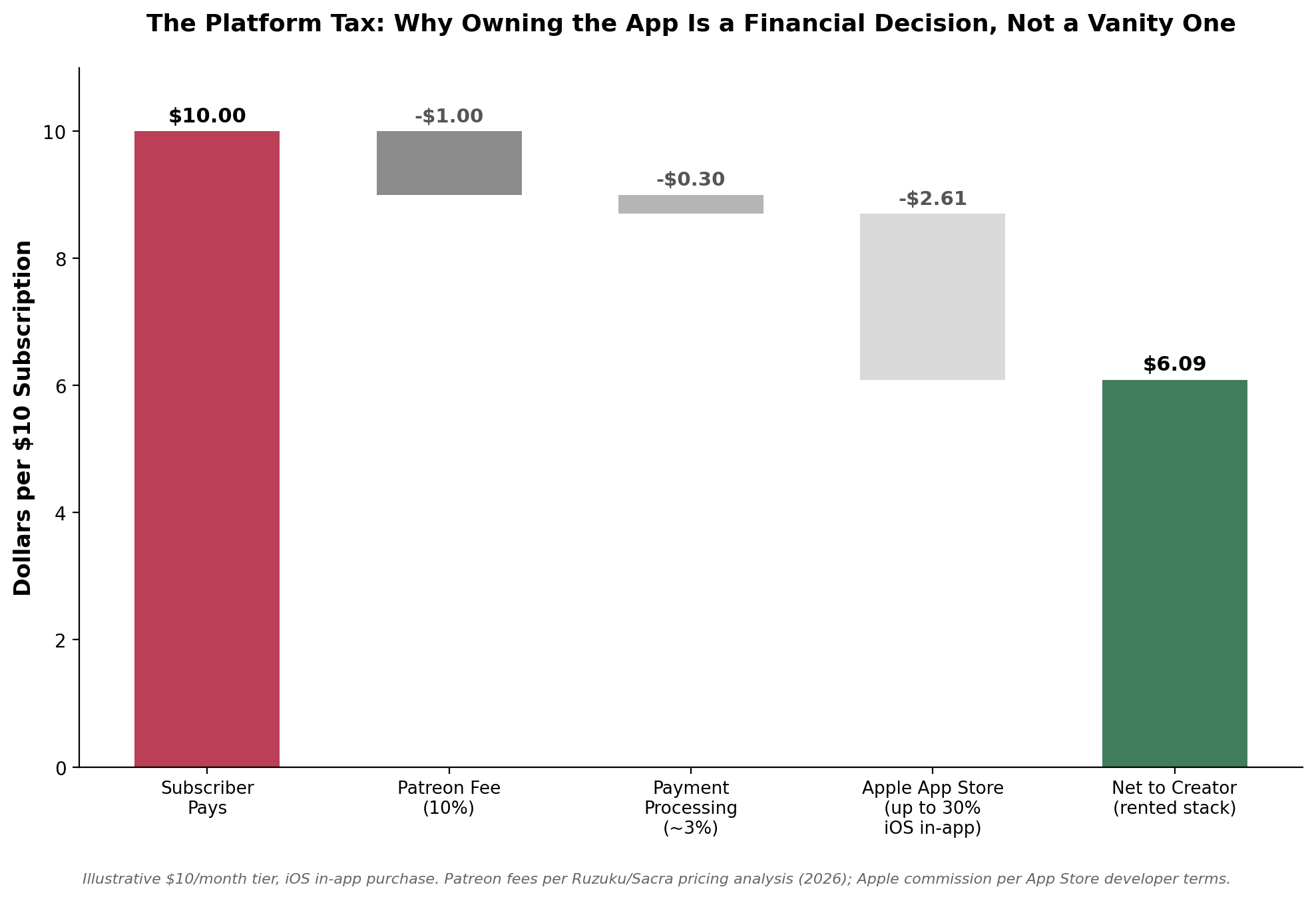
Owning the app doesn't eliminate Apple's cut entirely if you're still distributing through the App Store. But it does mean nobody else gets to unilaterally change your fee structure, your billing terms, or your access to your own subscriber data, the way Patreon has now done multiple times in the last two years.
WHY DISTRIBUTION ISN'T THE PROBLEM HERE
Every platform in mentioned in this article had to solve the same brutal problem first: get people to show up. X inherited Twitter's user base. Threads leaned on Instagram's three billion accounts to bootstrap overnight. Bluesky spent two years grinding out 41 million users one news cycle at a time, mostly off people fleeing X. Truth Social had to build an audience from a standing start with no existing platform to lean on, and its stock chart tells you how that's gone.
Budden and Schwartzman skipped that step entirely. They didn't need to go find an audience for a new social platform, they already had one, the same 70,000-plus paying Patreon subscribers and the audience behind 30 million monthly site visits. Standing up a new social network usually means years of cold-start user acquisition before you have anything worth selling. JBN launched with the users already inside the building.
That changes the economics of advertising too, not just membership revenue. A platform that has to beg for distribution takes whatever ad deal it can get, usually programmatic scraps sold through a network, at whatever rate the market sets. A platform that owns its own feed, with an audience it already controls, can sell ad placement directly inside that feed, and it can hold out for package sizes and rates that reflect the fact that the buyer has nowhere else to reach that exact audience. JBN already runs its own in-house ad sales operation instead of going through a network, on the podcast side. Owning the platform layer on top of that means the inventory they're selling against, the feed itself, is theirs to price, not a network's.
WHY THIS BLEEDS INTO EVERY CREATOR YOU FOLLOW
None of this stays inside hip-hop media. Every independent creator building an audience right now, YouTubers, newsletter writers, course creators, is running the same exact experiment, just usually without the leverage to finish it. A musician paying Stripe's processing fee. A writer splitting revenue with Substack. A trader running a Discord paying Whop 3% on every transaction. They're all building inside somebody else's house, and most of them will never get big enough, or patient enough, to move out.
That's what makes this move genuinely instructive rather than just a hip-hop media story. Budden and Schwartzman spent a decade positioning for exactly this moment, turning down $15 million here, $21 million there, $44 million with strings attached, in service of one outcome: not needing anyone else's pipes.
WHAT CHANGES FOR THE INDUSTRY
Look at how the market actually prices these two categories of business. Whop, a company that creates zero content and just sells payment infrastructure to creators, was valued at $1.6 billion in February 2026 after a $200 million investment from Tether, off roughly $3 billion in annual creator payouts. It's priced like fintech.
Patreon peaked at a $4 billion valuation after its 2021 Series F. Today it sits somewhere between $864 million and $1.5 billion, depending on which source you trust. Same infrastructure category. Completely different trajectory.
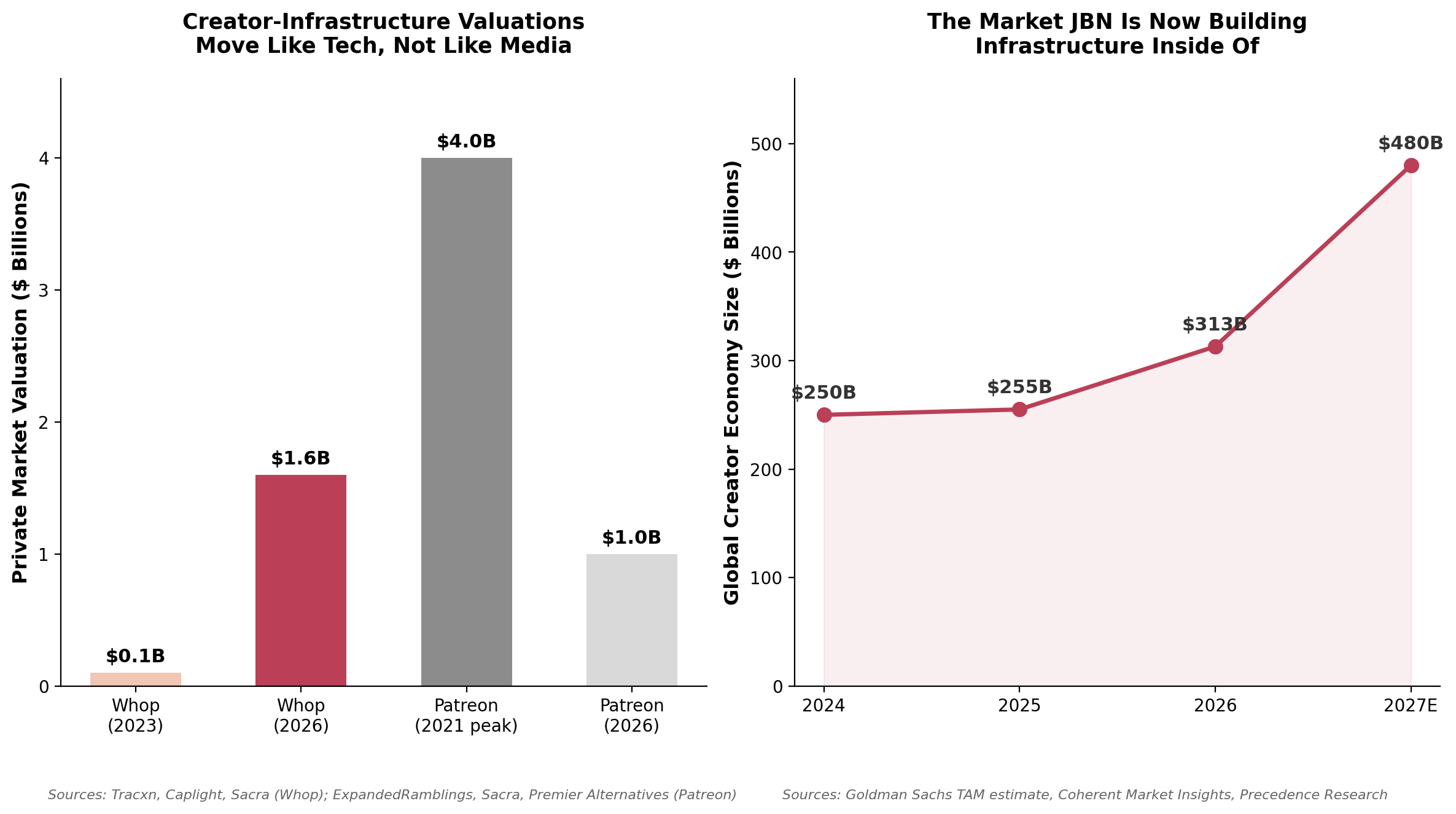
That gap is the whole thesis. A podcast gets valued on cash flow, usually a modest multiple of what it throws off in a year. A software or infrastructure company gets valued on growth, users, and payment volume, which is exactly how Whop is priced. Budden and Schwartzman just planted a flag in the second bucket instead of the first, whether or not the Joe Budden Community ever takes on a single outside creator.
The global creator economy just crossed roughly $313 billion and Goldman Sachs projects it could hit $480 billion by 2027. Podcast advertising, the category Budden's been in for a decade, crossed $2.86 billion in the US last year. Healthy growth, but it's a rounding error next to where the real money in this space is actually flowing.
The advantage that Budden and Schwartzman have is that what tech companies lack is distribution. Budden and Schwartzman have been building their own distribution channel for over 10 years. Now it's time to put it into action and compete right next to the other platforms.
THE CATCH
Nothing here is confirmed beyond what's been built for Joe's own audience.
There's no public indication that Schwartzman and Budden plan to license the Community platform out to other creators the way Whop or Mighty Networks do. That's the logical next door once you've built the house yourself, and it's exactly why the math above matters, but it remains speculation on my part until they say otherwise.
Owning the infrastructure also doesn't guarantee a tech multiple by itself. Patreon is proof of that. It's been "infrastructure" the entire time and its valuation has been cut by more than half since 2021. Building your own app is necessary if you want the option of software-style economics. It is not sufficient. Execution, scale, and whether anyone besides Joe Budden's own fans ever pay to use it will decide which bucket this business actually lives in five years from now.
Don't be stingy with the 🏀. Pass this to a friend.
See y'all next week,
CJB