

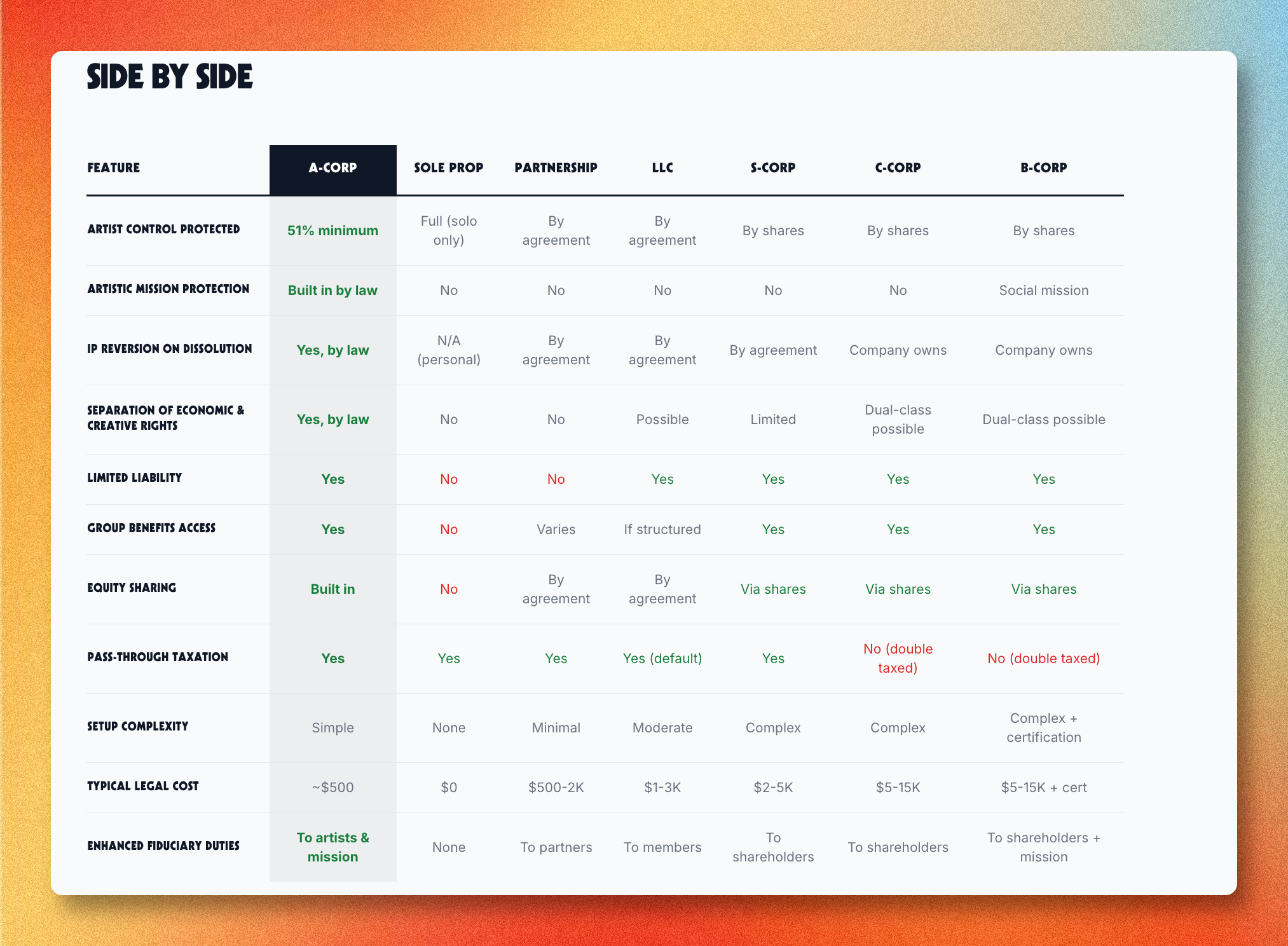
A-Corps are, by definition, limited liability companies and are subject to the same federal laws as all other LLCs. What sets them apart are their distinct guidelines around ownership, governance, and intellectual property rights.
The artist owns 51% of voting shares in an A‑Corp. That threshold is built into the law, so that the artist always has ultimate creative control over the company.
How this started
Last year, Carl and I dug into creators and IP. He outlined A‑Corps; I mapped the mechanics of investing in creators. Now the core of that model is on the verge of statute—and here’s how it would work.We recorded that episode in October. Eight months later, it is almost a law.
Here’s what it looked like then, as an idea:
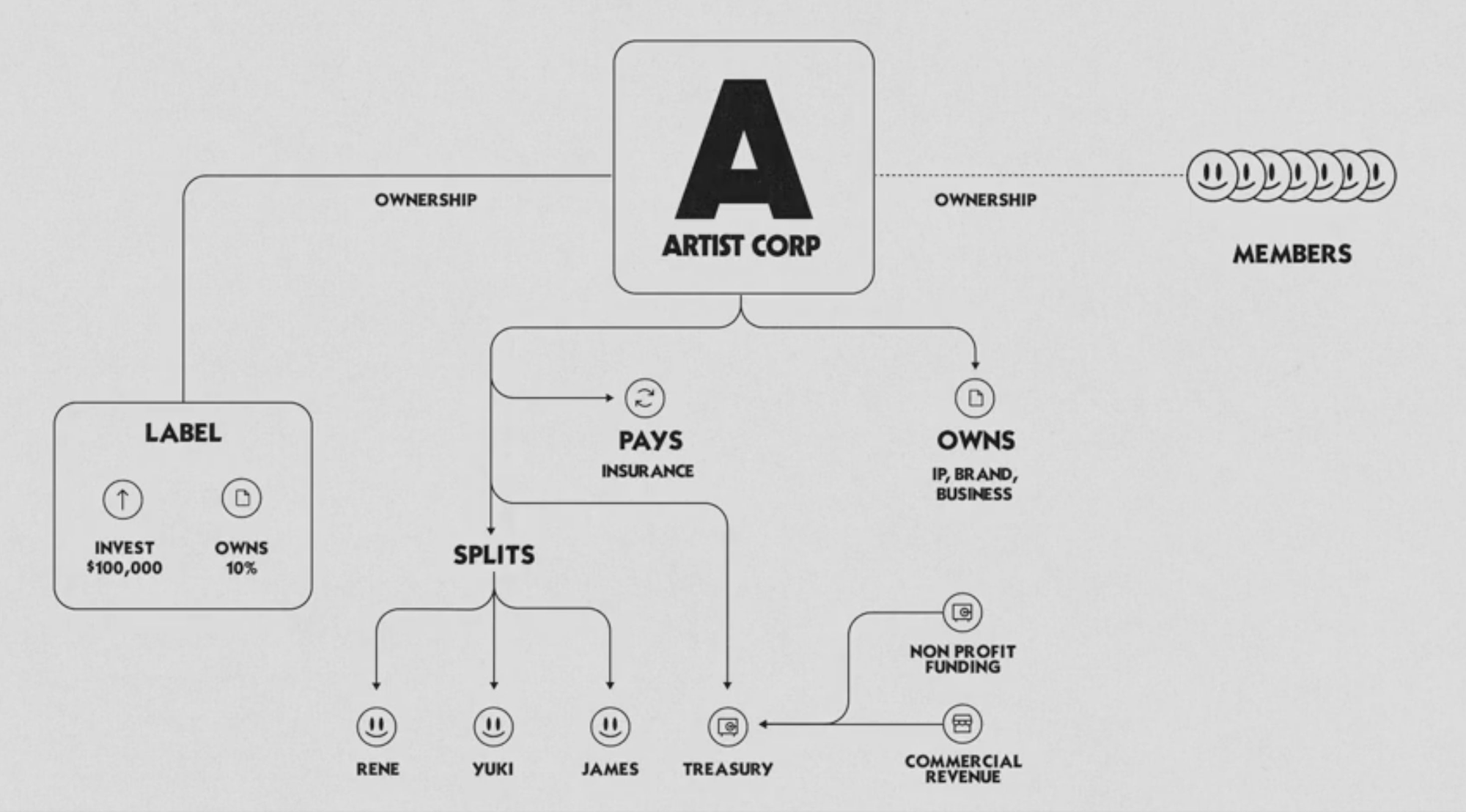
The core statues of an A-Corp:
- 51% Artist Control: Artists must own at least 51% of all voting securities at all times; this can’t be changed by contract.
- Artistic Mission: Every A‑Corp must have a stated artistic mission, which can be defined as superior to, equal to, or balanced with financial objectives.
- IP Protection: Artistic IP assigned or licensed to the company can’t be transferred to non‑artist investors or third parties; if the company dissolves, the work reverts to the artists and isn’t available to creditors.
- Separation of Rights: Economic rights (distributions, royalties, revenue participation) can be separated from governance/control rights, so investors don’t automatically get voting or creative control.
- Shares & Collective Ownership: A‑Corps can issue ownership units, including fractional units, treat creative work as in‑kind capital, and share equity with collaborators while artists keep majority control.
- Flexible Formation: By July 1, 2027, the Colorado Secretary of State must provide long‑form, check‑box / fill‑in‑the‑blank articles covering ownership, governance, IP terms, tax treatment, etc., so formation doesn’t require expensive lawyers.
#6 is HUGE. Traditionally company formation is a nightmare. Even with new tooling and AI, it’s still confusing, because depending on the state or jurisdiction you are in, the laws change and are not relevant to the environment.
The A-Corp presents a specific format for artists and creators that has a mix of other formulations, with some statutes that are legally binding, and others that are flexible.
The Musician Example
Let’s imagine three established musicians are making a collaborative album.
A major label pulls up with a deal. They propose:
- One‑album deal with a $500,000 advance, global distribution, and marketing spend.There’s a recording revenue split: 70/30 in favor of the label. The group has shared manager fees that takes 15% of gross profit.
- Mechanics: The $500,000 is effectively recouped from the trio’s 30%. Every dollar of recording income (streaming, downloads, neighboring rights) is split 70/30; their 30% goes to recoup the advance and label‑approved costs. Only what’s left becomes money they actually see.
Outcome: If the album hits, the label keeps 70% and most catalog value. If it misses, the trio keeps no masters and the long‑tail upside lives on the label’s balance sheet. The manager’s 15% comes off the top either way.
The A‑Corp approach
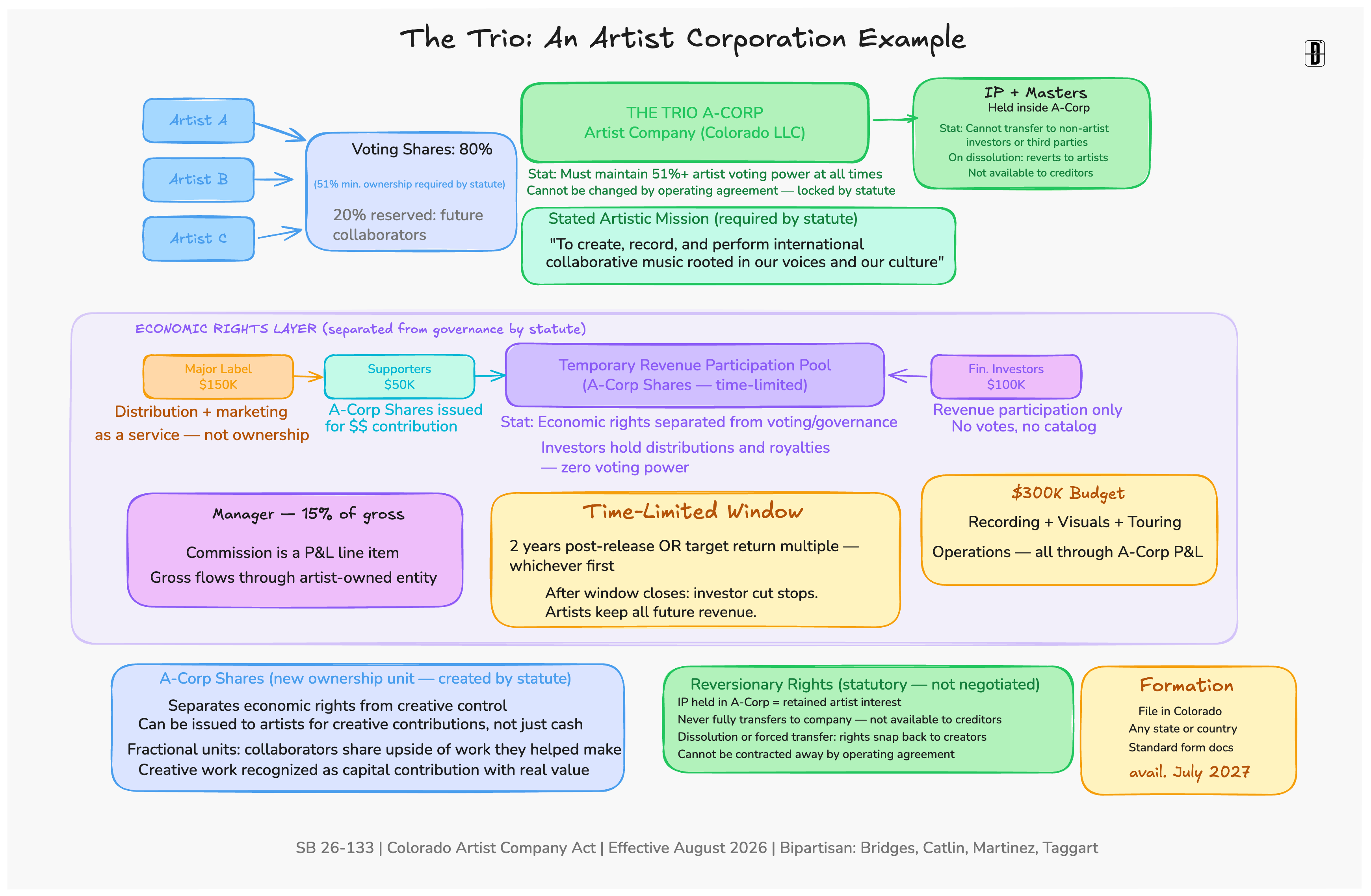
In this setup, the three artists have their A-Corp and have 80% of the company, and all of the voting rights. The other 20% stays unused for now, so they can bring in future collaborators without losing control. They plan a $300,000 budget for making the album, visuals, touring, and day‑to‑day costs.
Instead of signing a one‑album deal, the A‑Corp offers temporary revenue shares tied only to this album. A handful of supporters and two financial investors—including the major label—buy into these shares. In return, they get a percentage of the album’s net income: streams and sales from this album, the profit from touring tied to it, and any brand or sync deals specific to this project.
That payout lasts for a set window (for example, two years after release) or until the investors earn back a target multiple of what they put in—whichever happens first. After that, their cut stops. The artists keep the catalog and control.
Here’s what it looks like built out:
Current legal status
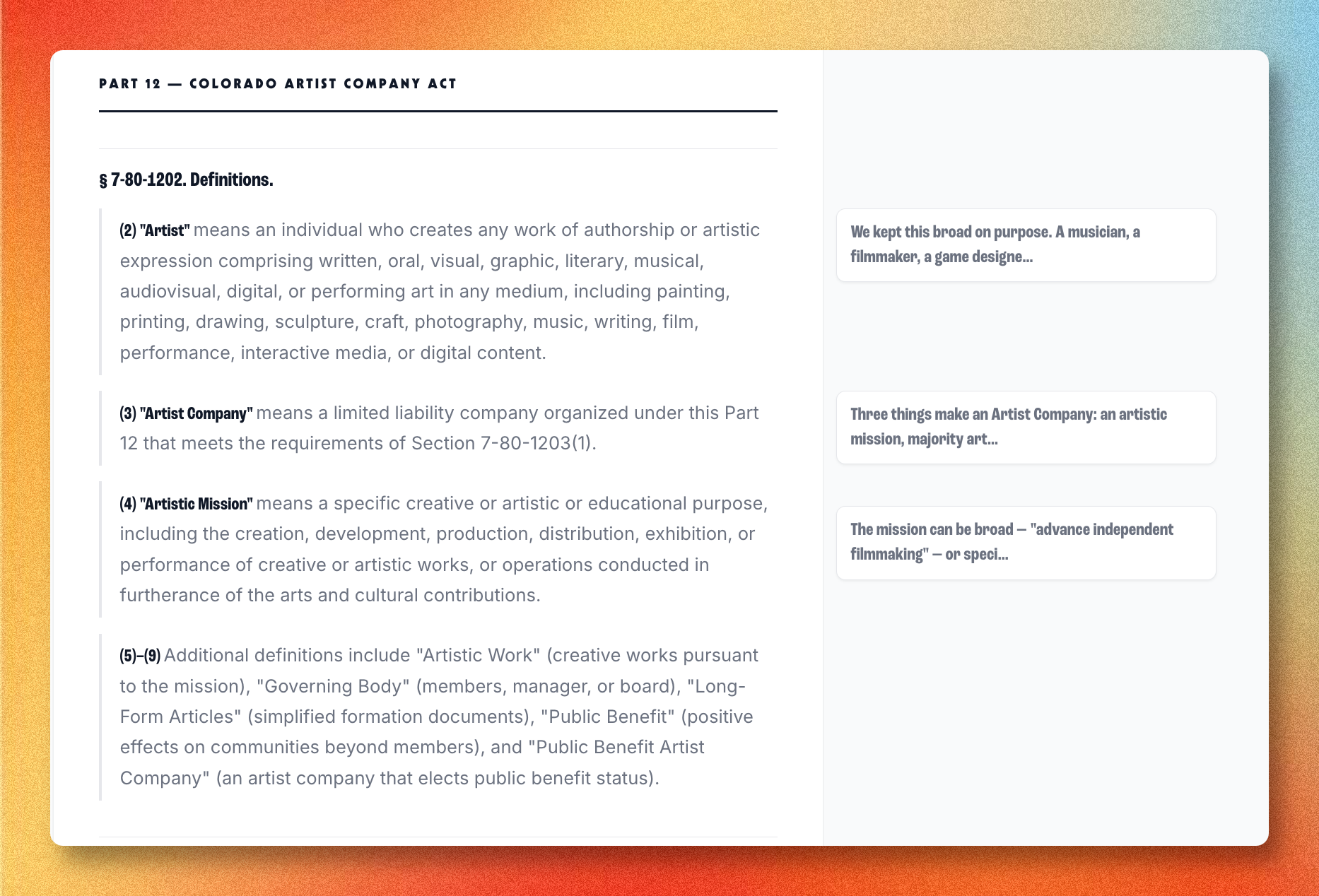
A‑Corps are proposed in Colorado as SB 26‑133 (Colorado Artist Company Act). Bipartisan sponsorship in both chambers; moving through the House as of April 22, 2026.
It’s not helpful to speak about upside without risks though. There are a few to keep in mind:
- Legislative risk: The bill may not pass or could be amended (e.g., weakening 51% voting or IP reversion).
- Adoption risk: Artists may not formalize; investors may prefer fewer constraints.
- “Too protective” risk: No transfer of IP to non‑artists removes some traditional exits (e.g., catalog sale to a big fund).
- Coordination risk: Without platforms, secondary markets, or funds, the form stays niche, and other types of capital struggles to interact with it.
- Perception risk: Could be read as anti‑investor rather than aligned‑investor, or push away people who want to be a part of it. This requires narrative liquidity to make it clear how people can work with it.
- Tax/valuation risk: Contributing IP as capital raises valuation and tax questions. Non-profit and for-profit blending gets dicey as well. Lawyers will be needed!
- Interstate recognition risk: Other states will recognize a Colorado LLC, but “artist company” nuances may be misunderstood outside CO, and require more interstate cooperation. Again, lawyers!
Why this is a big deal
This isn’t just a wrapper for a few artists; it’s a way to shift from patronage/labels/platform dependency to entity‑level finance with hard‑wired creator control.It encodes creator power at the statute level, letting artists present a structure investors can plug into without surrendering control. We know streaming by itself is not enough for music.
If creative output is under‑institutionalized relative to its economic role, A‑Corp is a rare attempt to build the missing corporate form—making an entire asset class more legible, easier to underwrite, and better protected.
Theory can become reality. You just need to decide where and how to push for it.